If you’ve spent any time reading about pokies, you’ve probably seen two terms come up again and again: RTP and volatility. They’re in game info screens, reviews and forum threads, usually with plenty of confident talk and not much explanation.
Here’s the short version. RTP tells you roughly how much of the money bet on a game gets paid back over a very long stretch of play. Volatility tells you how that money gets paid back: in small, steady amounts or in rare, bigger hits.
Neither number can predict your next spin. But once you understand both, you’ll have a much clearer idea of what a session on a particular game is likely to feel like. That’s useful when you’re deciding what to play and how much to spend, whether you’re at the local pub or browsing the games at LEON168.
What RTP actually means
RTP stands for return to player. It’s a percentage, set by the game’s developer, showing how much of all the money wagered on a game is paid back as winnings over its lifetime.
Say a pokie has an RTP of 96%. In theory, for every $100 wagered across millions of spins, about $96 goes back to players and $4 is kept. That $4 is the house edge, which is simply the other side of RTP (100% minus 96% = 4%).
The important part is “across millions of spins.” RTP is a long-run average across every player who ever plays the game. It doesn’t mean you’ll get $96 back if you put $100 in tonight. In one session you might double your money, or you might lose the lot. Both results fit perfectly well with a 96% RTP.
Australian regulators see it the same way. In pubs and clubs across NSW, Victoria, Tasmania, Queensland and the Northern Territory, land-based machines must have a minimum RTP of 85% (AIFS). Gambling Help Queensland points out that this return plays out over the life of the machine, usually three to four years, not over a single visit (Gambling Help Qld).
Online pokies commonly list RTPs in the mid-90s. A higher figure does mean a lower built-in cost per dollar you wager, so it’s worth checking. Just don’t read it as a promise.
Volatility: how the wins are spread out
If RTP is about how much a game pays back, volatility (sometimes called variance) is about the pattern. Two games can share the exact same 96% RTP and feel completely different to play.
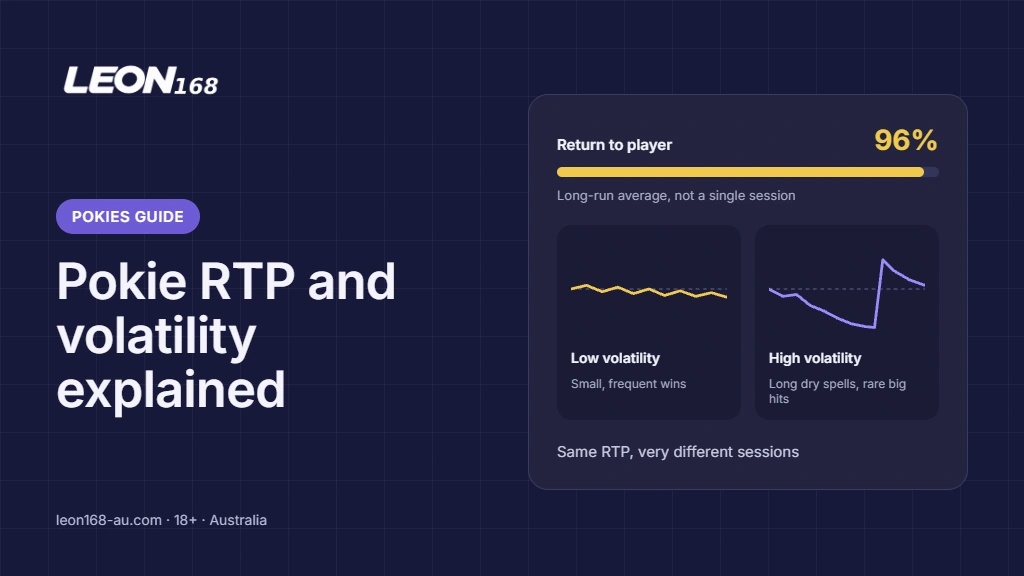
- Low volatility. Frequent small wins, often less than your stake, and fewer long dry spells. Your balance moves up and down slowly. These games suit longer, relaxed sessions on a modest budget.
- Medium volatility. The middle ground. Wins land fairly often, with the occasional bigger feature payout.
- High volatility. Long stretches with little or nothing, then the chance of a much bigger hit, usually inside a bonus round. Many Megaways, Hold & Win and bonus-buy games sit at this end. Your balance can drop quickly, and plenty of sessions end without the big win ever showing up.
Unlike RTP, volatility usually isn’t given as an exact figure. Developers tend to show it as a rating, like a row of lightning bolts or a simple “high” in the game info. The maximum win is another clue. A game that advertises a max win of 5,000x or more is almost always on the high-volatility side.
High volatility isn’t better or worse than low volatility. It changes the ride, not the long-run cost. You can see examples of each style in the pokies lobby.
How RTP and volatility work together
Picture two pokies, both with a 96% RTP, and a player who starts with $100 and bets $1 a spin.
On the low-volatility game, the balance might drift between $80 and $110 for a couple of hundred spins. Wins come often but they’re small, so the money lasts and the session feels steady.
On the high-volatility game, the same $100 could be down to $30 after 70 spins, with only a handful of minor wins along the way. Then a bonus round might land and pay 200x the bet. Or it might not land at all before the money runs out.
Over a huge number of spins, both games pay back the same share. Over one evening, they behave nothing alike. RTP describes the long-run cost; volatility describes the short-term swings you actually feel.
This matters with bonuses too. If you’re playing through a bonus that has wagering requirements, a high-volatility game can eat the balance before you’ve finished. Read the terms on offers like the welcome pack before choosing your games, and check whether any titles are excluded or count differently toward wagering.
How to check a game’s numbers (and a few myths)
Finding the figures takes about 30 seconds:
- Open the game and tap the info, paytable or “i” icon.
- Scroll through the rules. The RTP is usually listed near the bottom.
- Look for a volatility rating or a max win figure.
- Check the RTP on the site you’re actually playing on. Some developers release the same game at several RTP settings, so a number from a review may not match.
While we’re here, a few beliefs worth dropping:
- “This pokie is due a win.” Every spin is decided by a random number generator and has nothing to do with the last one. A game that hasn’t paid for a while isn’t any closer to paying.
- “A high RTP means I’ll come out ahead.” Any RTP below 100% means the game keeps a share over time. A higher figure just means a smaller share.
- “You can beat volatility with a betting system.” Raising your bet after a loss doesn’t change the maths. It only makes your balance swing faster.
Keep the numbers in perspective
The most honest way to think about RTP is as the price of the entertainment. A 96% RTP means that, over time, about 4 cents of every dollar wagered goes to the house. Volatility decides whether you pay that price a little at a time or all in one go.
So set your budget before you start, pick a game whose volatility fits that budget, and treat any win as a nice surprise rather than the plan. If you’d like extra guardrails, LEON168 offers deposit limits, session reminders and time-outs, all explained on the responsible gaming page.
Gambling is for adults 18+. If it stops being fun, free and confidential support is available 24/7 through Gambling Help Online or on 1800 858 858. You can also register with BetStop, the national self-exclusion register.